Understanding dew point
Fogged glasses
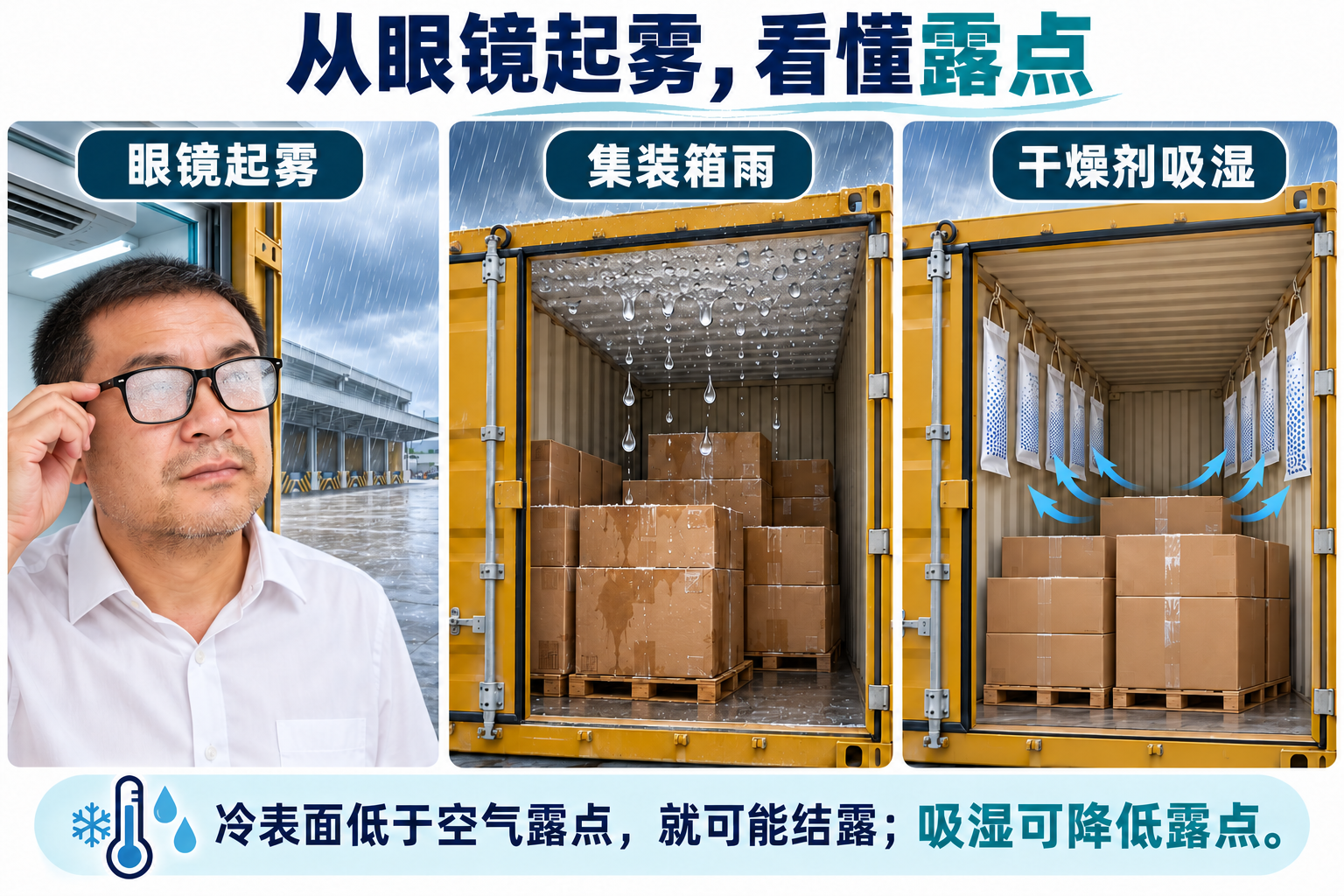
Container rain
Desiccant absorbs moisture
A surface below the air’s dew point may collect condensation. Removing water vapor lowers the dew point.
Glasses often fog suddenly when you leave an air-conditioned room for warm, humid outdoors. The lenses are relatively cold; when their temperature is below the outdoor air’s dew point, nearby water vapor condenses into tiny droplets.
Dew point is the temperature at which air, with substantially unchanged water-vapor content, cools enough for dew to start condensing. At the same air temperature, more humid air has a higher dew point, making condensation more likely on cold surfaces.
For example, at 35℃ and 85% relative humidity, the dew point is approximately 32.1℃. Lenses below 32.1℃ can then fog easily.
Containers can also “fog.” Sunshine during the day may cause cargo, cartons and wooden floors to release moisture. At night, or when sudden rain cools the roof, water vapor condenses if the inner roof surface falls below the dew point of container air. Droplets gather and fall onto cargo, creating “container rain.” Cargo may therefore get wet even without a rain leak.
Desiccants inside containers absorb water vapor and lower air humidity, thereby also lowering the dew point and reducing condensation risk.Quantity must be determined in conjunction with cargo moisture, packaging, voyage and temperature differences.
Before loading, cargo, packaging and the container floor should be as dry as practicable, and the container must not leak. Desiccants assist moisture protection and cannot replace these checks.
Reference:German insurance industry Transport Information Service: container climate and condensation. Dew-point examples are estimated using the Magnus formula. The illustration is an AI-generated diagram.