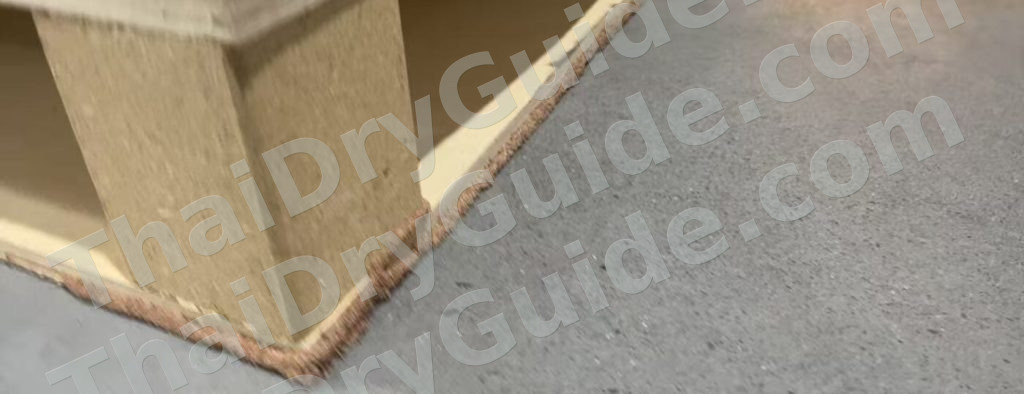
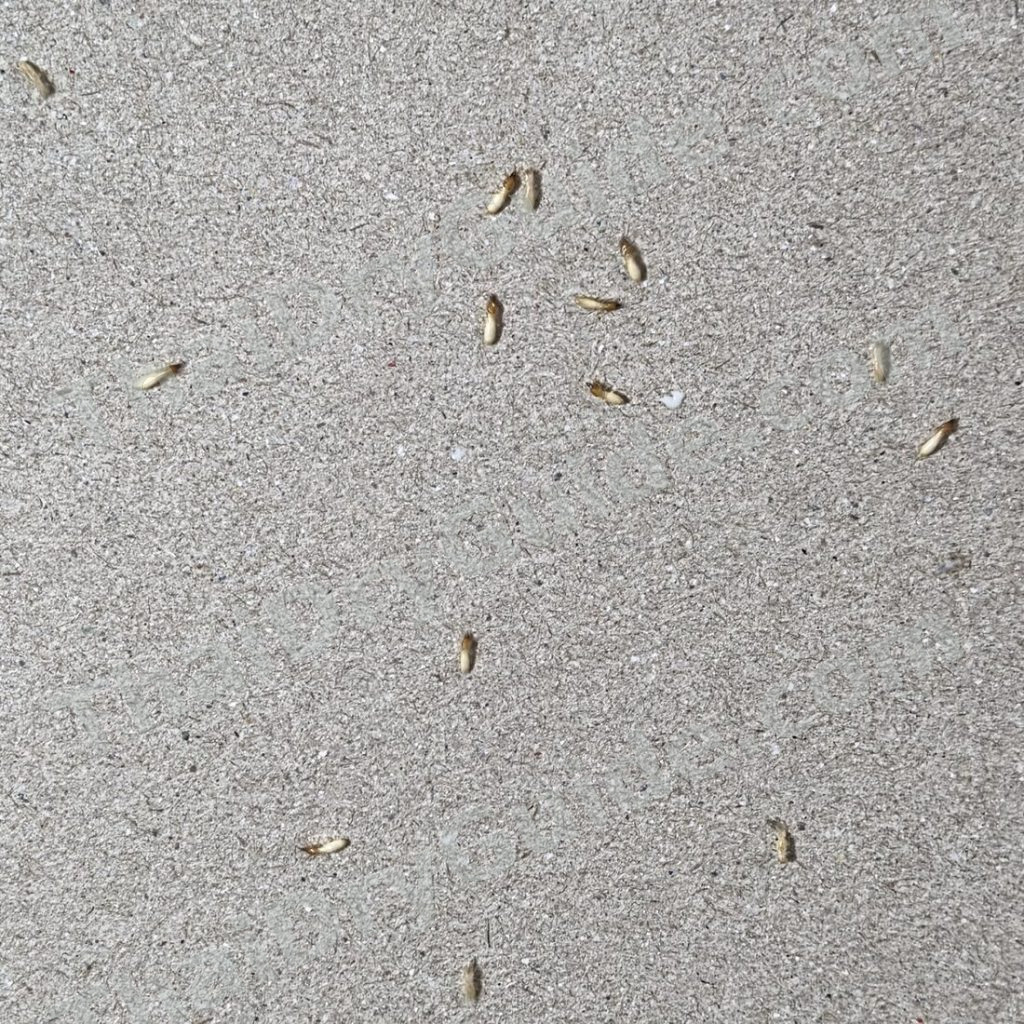
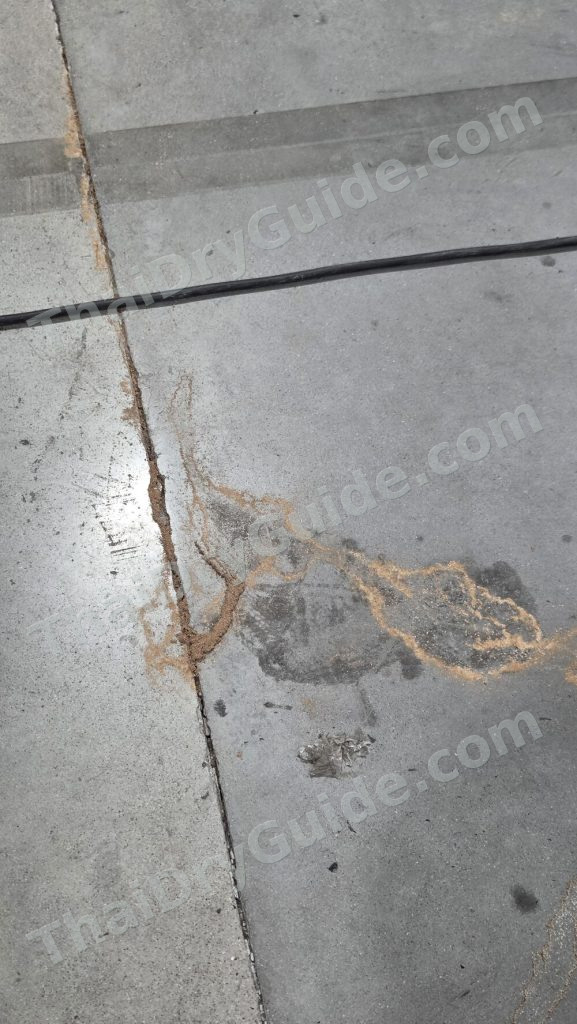
In late October 2026, during a stock check in a small warehouse in eastern Thailand, we found a band of reddish-brown mud along the bottom edges of several pallets. The bottom corner seam of a jumbo bag on one pallet was packed with soil and full of small creamy-white insects. When the pallets were moved, mud lines were also running out of the concrete floor’s expansion joint. Taken together, these signs show subterranean termites coming up through the floor joints from a nest under the slab and feeding on the pallets. This article uses our site photos to show how to confirm termites, the risks for warehouses and food plants, and the right order of action.
What we found


How to confirm termites
| Sign | Termites | Ants (look-alike) |
|---|---|---|
| Body | Workers creamy-white or pale yellow, translucent, soft | Usually black or reddish-brown, hard |
| Waist | Thick; no narrow waist | Clearly pinched waist |
| Antennae | Straight, like a string of beads | Bent at an “elbow” |
| Mud tubes / sheeting | Yes, made of soil, saliva and droppings to cover their runways | Usually none |
| Reaction to light | Avoid light; retreat into mud or cracks when exposed | Keep walking in the open |
Our photos show all three signs: creamy-white workers, mud tubes and mud sheeting, so this is termite activity. To identify the species (Thai warehouses commonly see Coptotermes, and Odontotermes, which spreads large mud sheets over surfaces), collect a few soldiers (large yellow-brown heads with mandibles) for your pest-control company. Treatment choice can differ by species.
Why they come up through floor joints
- Subterranean termites nest in the soil and travel to food through mud tubes. Expansion joints, cracks and pipe penetrations in a concrete slab give them a way in, even when the gap is narrow.
- They feed on cellulose: wooden and pressed-wood pallets, cardboard, cartons, kraft bags, and fibrous plant-based materials.
- Pallets left in one place for months create dark, damp conditions underneath — exactly what termites need.
- Thailand is warm all year, so termites are active all year. Swarms of winged adults around lights at the start of the rainy season mean a mature colony is nearby.
Risks for warehouses and food plants
- Pallets lose strength. Termites eat from the inside, so a pallet can look intact but be hollow, and a loaded pallet can collapse when a forklift moves it.
- Contamination. Soil, insects and droppings in bag seams, cartons and on product surfaces are foreign matter, leading to complaints or rejection at inspection.
- Packaging damage. Termites follow seams into packaging, and paper bags and cartons can be eaten through.
- Spread to the building. Door frames, wooden partitions, cable trays and filing cabinets are also at risk. By the time activity is visible, it has usually been going on for some time.
- Audit findings. Live insects and feeding damage in a warehouse are a major non-conformity in GMP, HACCP and customer audits.
What to do, in order
1. Do not spray or scrape away all the tubes yet
Spraying household insecticide on mud tubes only kills a few workers on the surface; the nest below is untouched. Disturbed termites change routes and move to other pallets or walls, which makes it harder for professionals to find the runways and place baits. Photograph and mark the locations and wait for the pest-control team.
2. Isolate and inspect the goods
- Move goods off affected pallets to a clean area and onto clean pallets.
- Check every bag’s bottom, seams and tie points and remove the soil. Isolate and assess any bag where soil has reached the liner or product; do not mix it with good lots.
- Inspect surrounding pallets, cartons, wall bases and door frames, and mark every mud tube.
3. Have a licensed pest-control company eliminate the colony
Two common methods, used alone or together:
- Baiting systems: bait stations at active sites; workers carry a growth-regulator bait back to the nest and the colony is gradually eliminated. Usually takes weeks to months, with very little active ingredient — a low-risk option for food warehouses.
- Soil termiticide barrier: drilling along expansion joints and wall bases and injecting termiticide into the soil under the slab. Faster, but goods must be moved during treatment and products must not contact food or packaging.
Ask for treatment records, product names and safety data sheets for your audit files.
4. Seal the joints after treatment
Once activity has stopped, seal floor expansion joints and cracks with an elastic sealant such as polyurethane to reduce entry points.
5. Switch to plastic pallets and move stock regularly
- Use plastic pallets in areas that have had termites. Remove damaged wooden and pressed-wood pallets from the warehouse; do not reuse them or stack them in corners.
- Keep goods at least 50 cm from walls with inspection aisles between rows.
- Move long-stored goods regularly and check pallet bottoms; do not leave a location untouched for months.
6. Monitor continuously
Inspect floor joints, wall bases and pallet edges weekly for new mud tubes, and keep records at the monitoring stations your pest-control company installs. Watch for winged termites around lights at the start of the rainy season.
Site checklist
| Check | OK | Not OK |
|---|---|---|
| No new mud tubes or sheeting at floor joints, wall bases or pallet edges | ☐ | ☐ |
| Pallets solid, no hollow sound when tapped, no holes | ☐ | ☐ |
| No soil or insects at bag bottoms and seams | ☐ | ☐ |
| Goods at least 50 cm from walls, with inspection aisles | ☐ | ☐ |
| No unused timber or cardboard stored in the warehouse | ☐ | ☐ |
| Floor expansion joints and cracks sealed | ☐ | ☐ |
| Monthly monitoring-station records; pest-control record current | ☐ | ☐ |
Note: photos were taken by ThaiDryGuide in a Thai warehouse. Choice of termiticide, dosage and application must follow Thai regulations and be carried out by qualified professionals.