Choose desiccants by moisture load, target humidity, protection period and containment reliability, not bag weight or price alone. This illustrated example covers soybean flour shipped from Laem Chabang, Thailand, to Qingdao, China.
1. Container protection and sealed-package protection
Container protection aims to lower the air dew point and reduce condensation on container surfaces. In-package desiccants control a sealed local space. A hanging container desiccant does not directly establish the moisture content of flour inside a sealed liner. These tasks may require separate designs depending on packaging permeability.
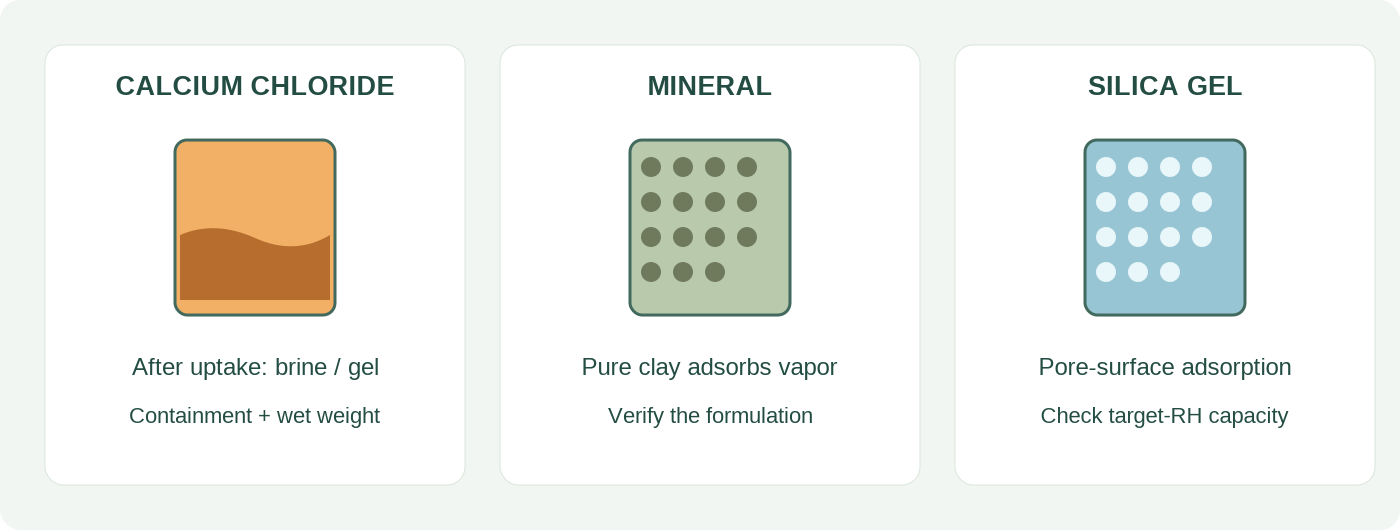
2. Comparing three desiccant types
| Type | Characteristics | Common applications | Check before buying |
|---|---|---|---|
| Calcium chloride | Typically high uptake capacity at high humidity. Forms brine; some formulations immobilize water in gel. | Long marine transport, larger moisture loads and container condensation control. | Uptake curves, calcium chloride content, leak containment, orientation and wet installed weight. |
| Mineral | Examples include bentonite and montmorillonite. Pure clay adsorbs vapor and generally remains solid. | Sealed packages or local protection; container use also requires adequate effective capacity. | Exact composition, added salts, dust, packaging strength and climate performance. |
| Silica gel | Adsorbs vapor in pores and generally remains granular; grades differ. | Sealed packaging for electronics, machinery, foods and other goods; calculate container use separately. | Capacity at target RH, uptake rate, dust control and package vapor barrier. |
“Mineral” is not one formulation: pure clay and clay/calcium chloride mixtures must not be treated as identical. Solid form does not eliminate contamination risk, and gel formation does not guarantee zero leakage.
3. Five selection criteria
Water sources and quantity
Include air, cargo, wood, cartons, dunnage and the container floor.
Protection target
Preventing roof drips differs from maintaining low RH inside a sealed package.
Duration and climate
Count loading to unloading, including port waits and land transport, plus route and day/night temperature changes.
Reliability after uptake
Check seals, compression, dust, brine or gel containment and load on the fixing.
Cost per effective capacity
Compare equal temperature, RH and duration; distinguish fill net mass from whole-bag mass.
4. Case: 20 bulk bags in a 20 ft container
| Item | Case conditions |
|---|---|
| Cargo | 20 bulk bags × 1.04 t = 20.8 t of soybean flour. |
| Container and pallets | 20 ft standard dry container, no pallets. Check the wood floor for dampness. |
| Lining | Corrugated board on four walls; it buffers moisture and separates cargo from steel, but is not a substitute for a water barrier or desiccant. |
| Route and duration | Laem Chabang to Qingdao, about 15 days. Add waiting and land transport if this counts sailing time only. |
| Climate assumption | 30°C and 80% RH for illustration, not a measured day or an October-wide climate claim. Record actual conditions inside the container at loading. |
| Missing inputs | Liner and closure details, flour moisture content, desiccant model and 15-day uptake curve. |
5. Why provisionally trial eight bags?
A published manufacturer guideline recommends 3–4 units of a particular 1.5 kg calcium chloride product for a 20 ft container: 4.5–6 kg, subject to cargo and conditions. This is product-specific, not universal mass equivalence. For this large flour load, moisture-exchanging board and unknown liner permeability and cargo moisture, this article selects 8 kg as a trial to verify with shipment records.
At 30°C and 80% RH, the dew point is approximately 26.2°C. Surfaces below that temperature may condense water. Even using the full empty-container volume of about 33.2 m³, air vapor totals only about 0.8 kg; loaded free-air volume is smaller. This is not the required desiccant capacity because cargo, board and floor continue exchanging moisture.
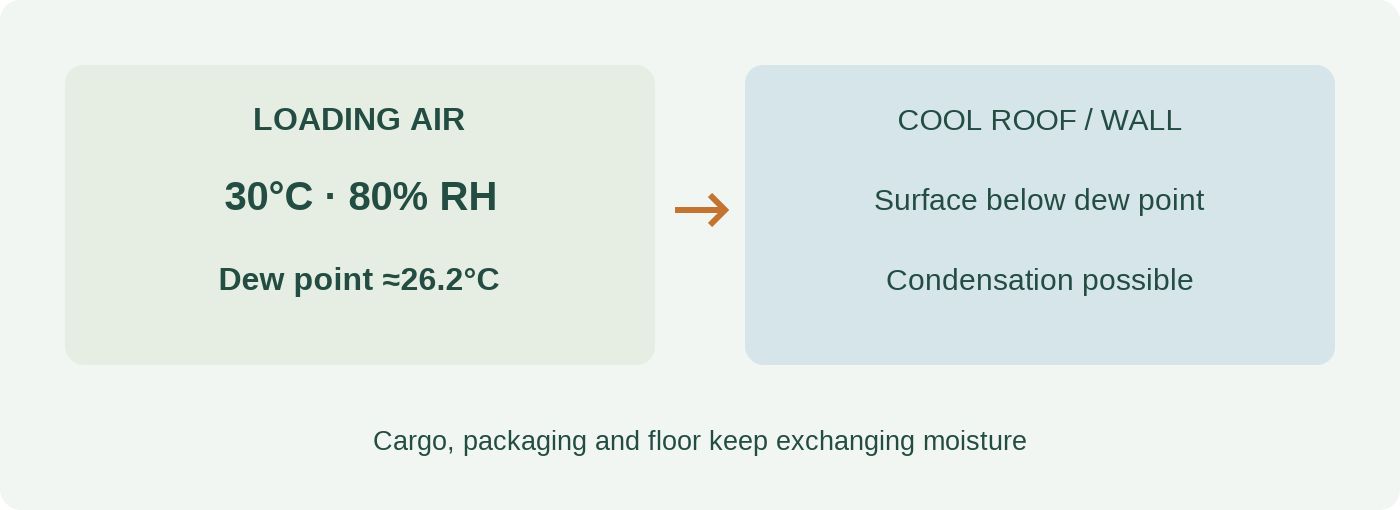
For scale, water equal to just 0.05% of a 20.8 t cargo mass is 10.4 kg. This is not a prediction that the flour will release 10.4 kg. Actual release needs moisture, permeability and time-dependent climate data.
A “maximum uptake of 300%” does not mean every bag takes up 3 kg of water within 15 days. Obtain curves for the intended conditions. If a tested product effectively takes up 1.5 kg per bag over that period, eight bags provide about 12 kg; 1.5 kg is a calculation example, not an established rating for this shipment. Uptake speed must also keep pace with cooling events.
6. Installation of the eight bags
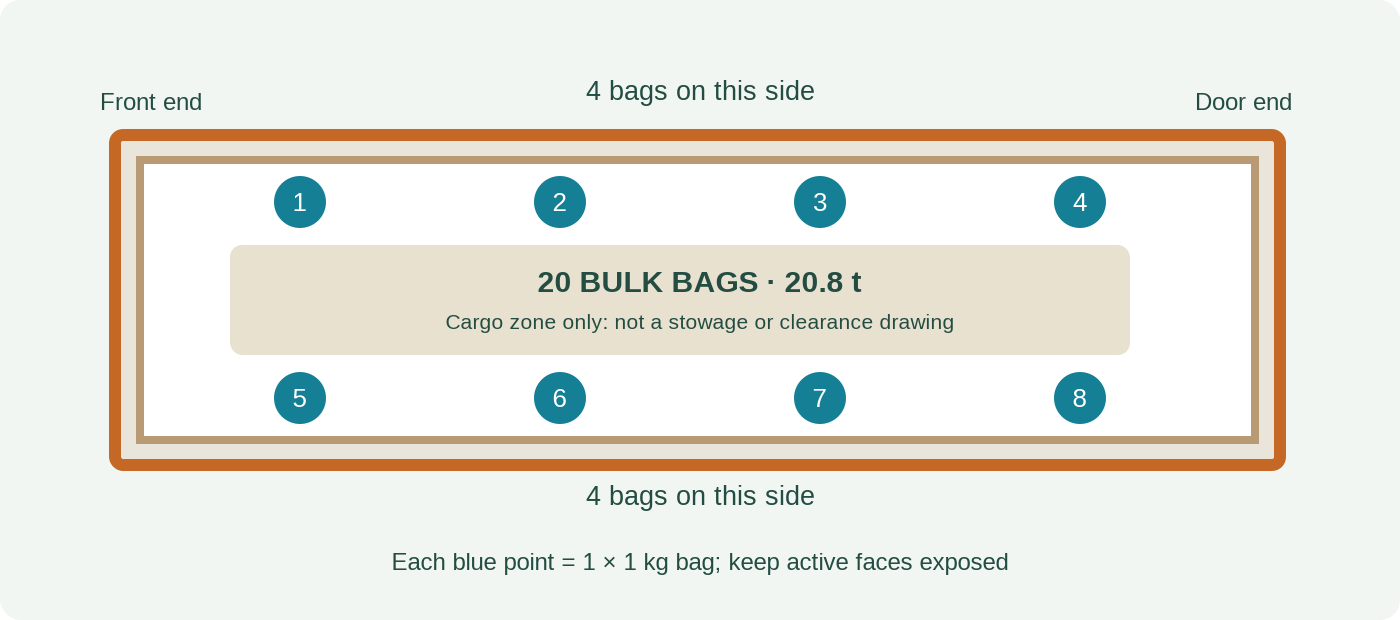
Four along each side
Distribute along the length using the manufacturer-approved direction and fixing. The diagram shows relative distribution only.
Keep the active surface exposed
Do not cover it with board or squeeze it between bags and steel. Preserve the clearance specified for the product.
Prevent rupture and falling
Fixings must carry the wet weight. Avoid sharp edges, nails and abrasion against food packaging.
Inspect before sealing
Floor, board and bag exteriors should be dry, without standing water or rain wetting. Open desiccant barrier packaging shortly before loading.
7. Verify at arrival and refine the next shipment
Record container ID, cargo moisture, bag construction, loading climate, product model and lot, and installation positions. Use at least one suitably placed temperature/RH logger; add upper or door-area points where practical. Check condensation, board stains, bag exteriors, desiccant damage and weight gain at arrival. Weight gain helps assess uptake but cannot alone prove an absence of condensation throughout the journey.
Correct wet cargo, damp board or a wet floor before loading; more desiccant is not a substitute for drying or container repairs. To refine the eight-bag trial, obtain the product specification, liner and closure details, and loading moisture content of the flour.
References and limits
Basis: Clariant, Container Dri II Cargo Desiccant configurations and usage recommendations; Desiccant Bags; Absortech, Container Desiccants and FAQ; USDA Forest Products Laboratory, Wood Handbook moisture relations. Dew point uses a common Magnus approximation. The 8 kg trial is this article’s case judgment, not a universal manufacturer guarantee. Original explanatory diagrams. Checked 18 October 2026.